Magnetic colloids & self-assembly
Field-driven synchronization, anisotropic interactions, phase behavior and programmable structures in magnetic particle systems.
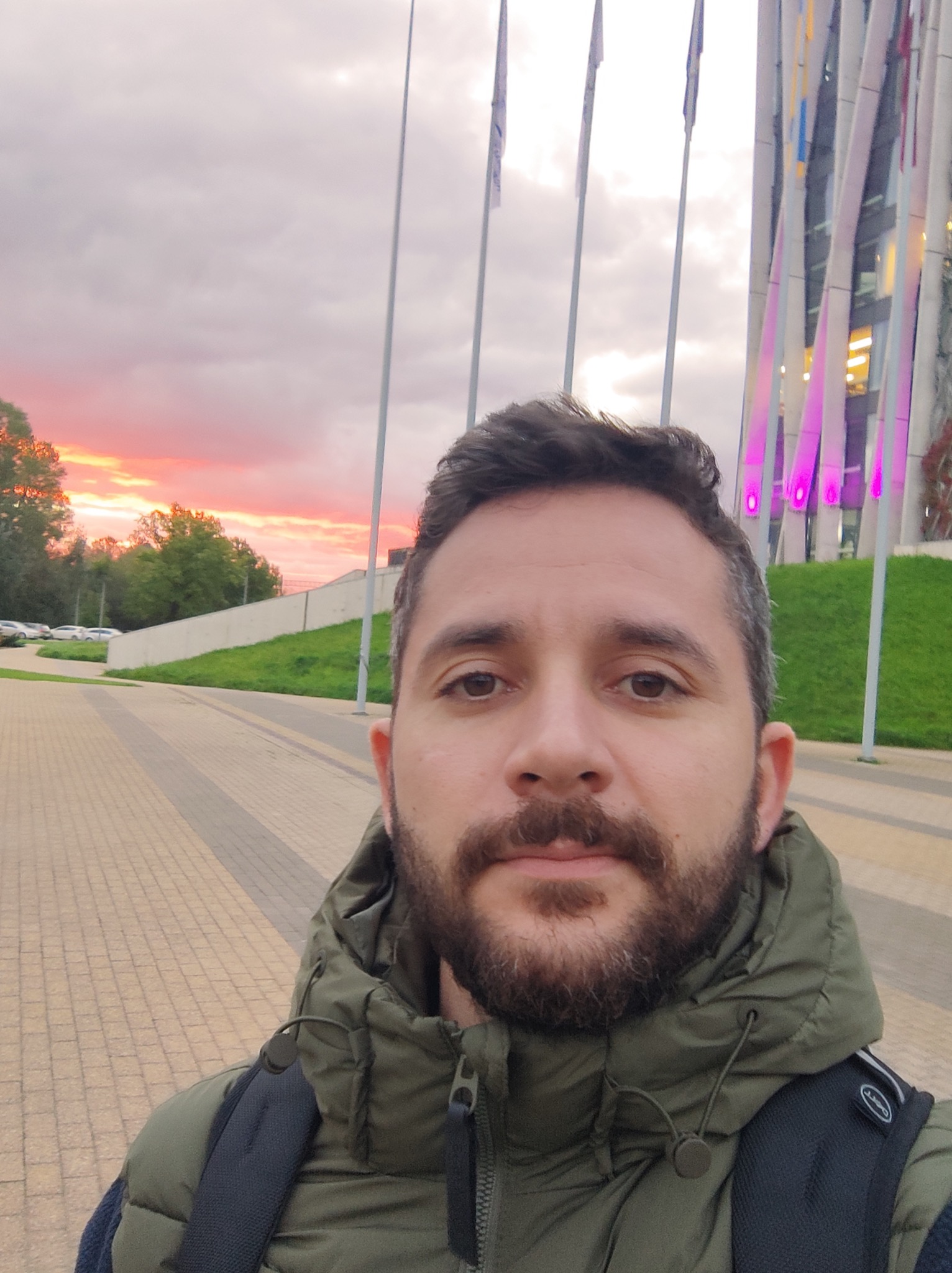
Visiting Researcher · University of Latvia
Computational soft matter, active systems and magnetic colloids
I investigate how microscopic interactions, particle geometry and external fields generate collective motion, structure and function in complex systems.
Research profile
My work combines particle-based simulation, statistical physics and theory to identify the mechanisms that govern self-organization in soft and active matter. I am particularly interested in systems whose response can be programmed through geometry, confinement or time-dependent fields.
My current interests increasingly explore the bridge between soft matter and biology: how mechanics, geometry, interactions and transport organize living and bio-inspired systems across scales. At the University of Latvia, I worked on the EU-funded PattSpin project, completed in 2026, on pattern formation in magnetic spinners, alongside broader collaborations in colloids, active matter and molecular biophysics.
Research
The programme is organized around three connected questions: how particles assemble, how active systems transport and reorganize, and how computation can link microscopic mechanisms to measurable observables.
Field-driven synchronization, anisotropic interactions, phase behavior and programmable structures in magnetic particle systems.
Vortex formation, directed transport and the role of obstacles, disorder and confinement in active particle dynamics.
Molecular simulation and particle-based models that connect soft-matter principles with biological interactions, transport and organization in complex environments.
Research in motion
 01 / 04
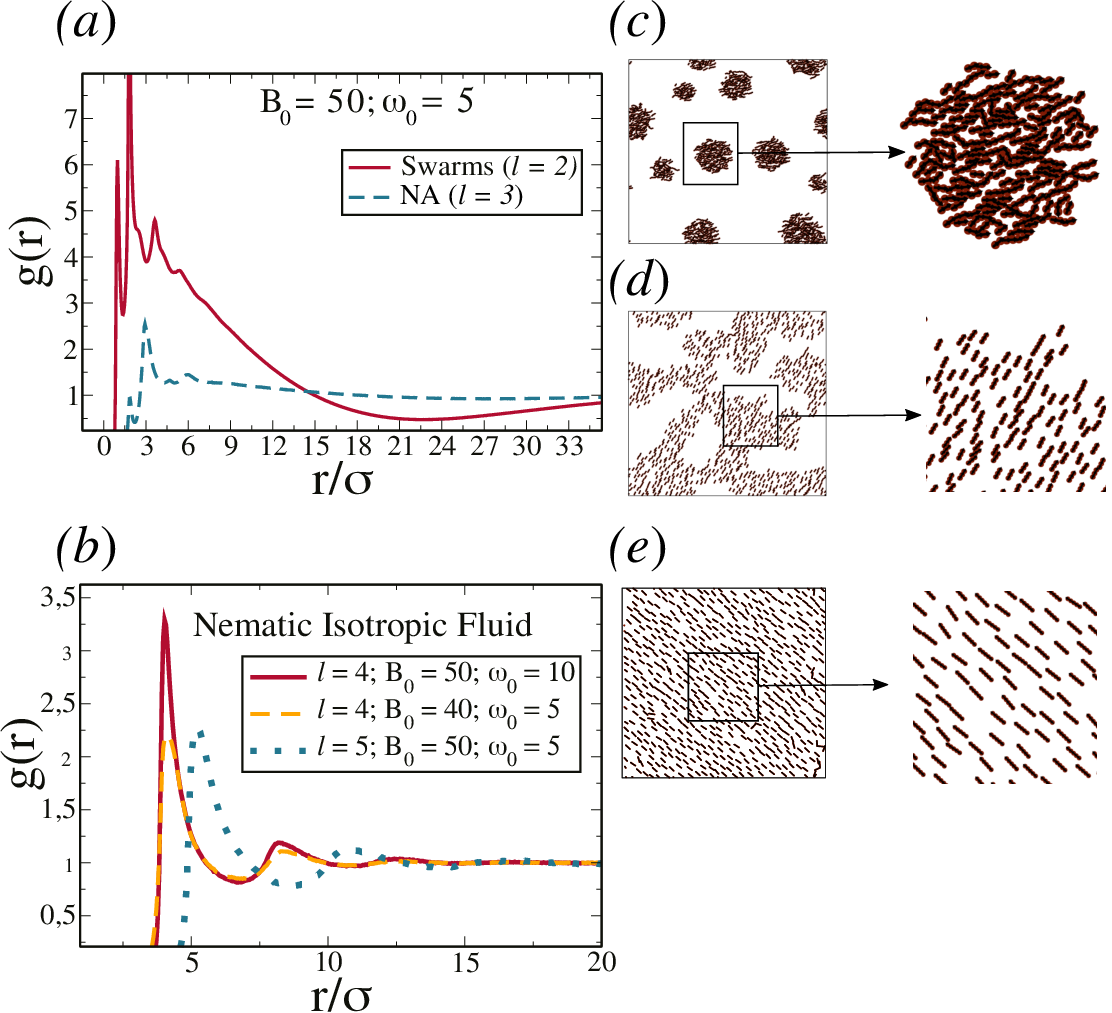
Pair correlations and representative swarms, nematic aggregates and nematic isotropic fluids formed by magnetic rods.
Domingos et al., Soft Matter 21, 488–498 (2025)Publications
Peer-reviewed work, ordered from most recent. Article titles link to the publisher or DOI record.
Current Opinion in Colloid & Interface Science · 84, 102039
Physical Review E · 113, 054119
Soft Matter · 21, 488–498
Physica A: Statistical Mechanics and its Applications · 656, 130181
Anais da Academia Brasileira de Ciências · 96 (Suppl. 3), e20230677
Journal of Biomolecular Structure and Dynamics · 40, 6817–6830
Soft Matter · 16, 1201–1210
Physical Review E · 101, 022601
Journal of Molecular Modeling · 26, 22
PLOS ONE · 13, e0195552
Physical Review E · 96, 012603
PhD thesis
Estudo de sistemas coloidais de partículas magnéticas conduzidas por campos oscilantesFiziM052 · 3 ECTS · English
PhD Programme(līm.), Jorge Luiz Coelho Domingos
Prerequisite knowledge required for the acquisition of the course corresponds to the study programme admission requirements and the general knowledge, skills and competences obtained at the previous level of education.
The aim of the study course is to establish an understanding about different types of soft nanomaterials, their applications and related theoretical study methods.
Tasks of the course are to:
| No. | Topic | Hours |
|---|---|---|
| 1 | Introduction: aim and content of the course. What is soft matter? Types of soft nanomaterials | 3L |
| 2 | Scales in soft matter: energy, time, and length scales. Interactions in soft systems | 3L |
| 3 | Brownian motion and thermal fluctuations. Langevin equation (conceptual and quantitative) | 4L |
| 4 | Colloids: diffusion, Stokes law, stability and effective interactions | 3L |
| 5 | Liquid crystals: nematic order, order parameter, and basic phenomenology | 3L |
| 6 | Complex fluids and rheology: viscoelasticity and basic models | 3L |
| 7 | Microfluidics: low Reynolds number flows and applications | 3L |
| 8 | Magnetic soft matter: dipolar interactions and field-driven behavior | 3L |
| 9 | Active matter: basic concepts and examples (including magnetotactic bacteria) | 3L |
| 10 | Guided discussion of research papers and project preparation | 4S |
| Total | 28L · 4S | |
During this course students' work will involve:
At the beginning of the course students will be introduced to principles of preparing deliverables. Consultations (both remote and in person) will be available for unclear questions.
Students may take the final examination only if all interim assessments and other mandatory requirements have been successfully completed (where applicable).
Final grade consists of:
| Component | Assessment | Weight |
|---|---|---|
| Intermediate tests | Homeworks | 50% |
| Final examination | Final project defense by oral presentation | 50% |
In accordance with Regulations of the Cabinet of Ministers of the Republic of Latvia, at the end of the course, students' knowledge is evaluated according to the following criteria: the amount and the quality of the obtained knowledge, acquired skills and competence in compliance with the planned learning outcomes.
| Type of Assessment | 1 | 2 | 3 | 4 |
|---|---|---|---|---|
| Homeworks | — | + | + | — |
| Exam | + | — | — | + |
Plagiarism and other academic misconducts are not permitted within the course; please refer to the Regulations for Academic Integrity at the University of Latvia. Within this course, the use of generative artificial intelligence (AI) tools is allowed in exceptional cases, if it has been specified and authorised in writing by the instructor of this course. In all other cases, submission of materials generated by AI (text, images, audio, video, etc.) in independent and group assignments, test, examination or any other assessment is not permitted. Submission of this type of material will be considered an unauthorised use of aids.
Research projects & collaboration
The emphasis is on the scientific question, funding context and collaborative network of each project.
Pattern formation in systems of magnetic spinners
A completed EU-funded project investigating how anisotropy, synchronization and rotating magnetic fields select collective structures.
Structural pattern formation in driven magnetic systems
Computational research on emergent patterns and dynamical regimes in field-driven magnetic particle assemblies.
Numerical simulation of water invasion in production wells
Particle-based modelling of transport and interface dynamics in a project connecting fundamental simulation with an industrial problem.
Funding & institutional partners





Outreach
Self-assembly is a direct way to show how simple microscopic rules can generate rich macroscopic behaviour. I use simulations, figures and accessible explanations to connect soft-matter concepts with materials, transport and living systems.
A visual introduction to collective organization and synchronization in magnetic particle systems.
Space prepared for upcoming talks, lectures and community events.
Space prepared for simulations, animations and hands-on demonstrations.
Space prepared for accessible articles, media and teaching resources.
Contact
For collaborations, seminars, student projects or scientific exchange, contact me by email or through the profiles below.
Faculty of Science and Technology · University of Latvia · Riga